
How to Navigate Within & Around Boston
Thinking about moving to Massachusetts – specifically the Greater Boston area – without a car? Good news, this region is one of the most public-transit-friendly places in the U.S., making it easy to live, work and play without owning a vehicle! Whether you’re commuting to work, heading out for a night in the city, or taking car-free day trips to explore beyond Boston, you’ve got plenty of options.
No Need For a Car in Boston
Boston consistently ranks among the most walkable cities in America, with a compact layout and robust transportation network. From trains to buses to ferries, you can traverse the city and surrounding communities without sitting behind the wheel. And with Keolis massAdventures, you can enjoy day trips from Boston by train that take you directly to some of Massachusetts’ most exciting destinations, no car (or rideshare) required!

Your Public Transportation Options in Greater Boston
1. MBTA Subway (The “T”)
The MBTA subway, known locally as the “T”, is Boston’s rapid public transit rail system. These trains connect urban communities near the city with the downtown area. The “T” has four main lines, distinguished by colors.
- Red Line: Runs from Cambridge through Boston to Quincy and Braintree.
- Orange Line: Connects Malden, Somerville, downtown Boston, and Jamaica Plain.
- Blue Line: Travels from Revere to downtown Boston near Beacon Hill, stopping at Logan Airport.
- Green Line: Serves Boston University, Boston College, and Brookline, with branches into Somerville and Medford.
Inbound vs. Outbound
When arriving at “T” subway stations, you’ll almost always see signs directing you “Inbound” or “Outbound”. “Inbound” trains will always take you towards downtown Boston, while “Outbound” trains will take you away from downtown. Four downtown transfer stations serve as centralized hubs for “Inbound” and “Outbound” trains, and at the same time also connect different lines. These downtown stations are: Park Street, State Street, Government Center, and Downtown Crossing. At these stations, you have officially arrived “Inbound” in downtown Boston and therefore cannot go any further inbound. You can travel to other hub stations, or you can travel away from the hub stations on an “Outbound” train.
Buying Tickets
Subway tickets are valid for travel on the Red, Orange, Blue, and Green Lines; as well as the Mattapan Trolley and the Silver Line routes SL1, SL2 and SL3. Tickets come in several different options, including CharlieCard and CharlieTicket, as one-way fares, 1-Day Passes, 7-Day Passes or Monthly LinkPass. Subway fares are flat-rate, no matter how far you’ll be traveling. The CharlieTicket is best for visitors, because it can easily be purchased at kiosks in any station. With the CharlieTicket, your 1-Day or 7-Day Pass is valid from the date and time of purchase. Subway fares can also be paid via contactless payment at the fare gate by tapping your card or device on the Charlie reader.
Need to Go in a Different Direction? Transfer Lines
Transferring lines can seem intimidating, but it’s actually very easy. First, look at which line you’ll be on, and which line you want to switch to. Once you’ve done that, find out which hub you’ll need to transfer at. When you arrive at that hub, disembark your train but do not fully exit the station. Instead, follow the signs to the line you want to transfer to, then hop aboard the train!
For example: You are traveling into Boston to attend a Red Sox game, coming from Quincy. You’ll arrive at the nearest “T” Station – Red Line Station: Quincy Center. Don’t forget to buy your train ticket at the station, then board the “Inbound” train. You’ll ride the Red Line until Park Street, where you’ll disembark. You’re transferring lines now, and in this case, you’re looking for a ‘B’, ‘C’ or ‘D’ Green Line train. Hop aboard any of those three, and ride until the Kenmore stop, where you’ll disembark and walk the short distance to Fenway Park for the Red Sox game.
Note: When you purchase a CharlieCard, CharlieTicket, or pay with contactless payment, you can transfer up to two times and pay only the cost of the highest-priced service when riding the subway, Local Bus, Express Bus, or the Silver Line. There are no free transfers when paying via cash.
Schedules & Map
Train schedules vary by train, with service on some lines starting as early at 5 AM and running as late as 1:50 AM. Check the MBTA website for the most up-to-date schedules. A map of the “T” can be found online and in stations. Be sure to note both your origin station and destination station when making your plans.

2. MBTA Commuter Rail
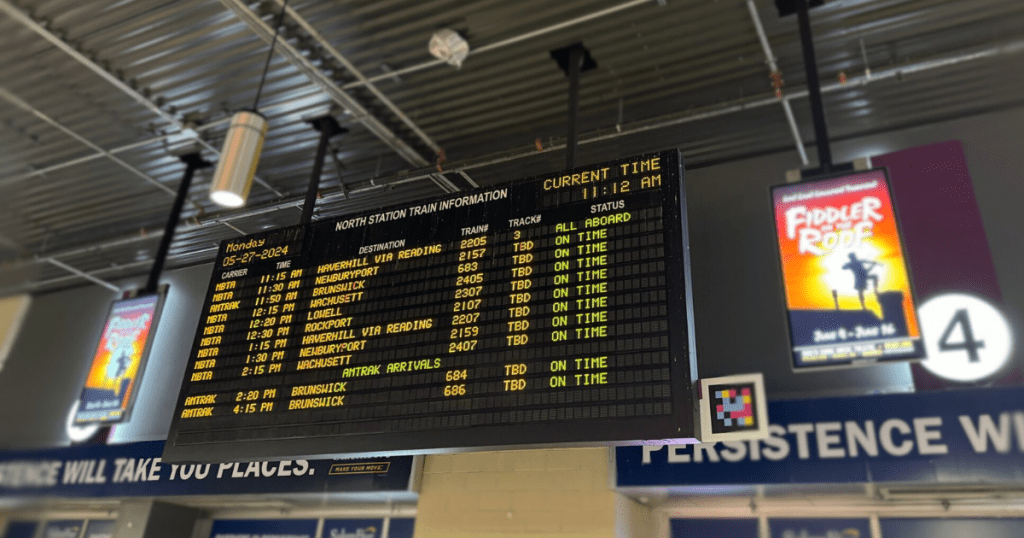
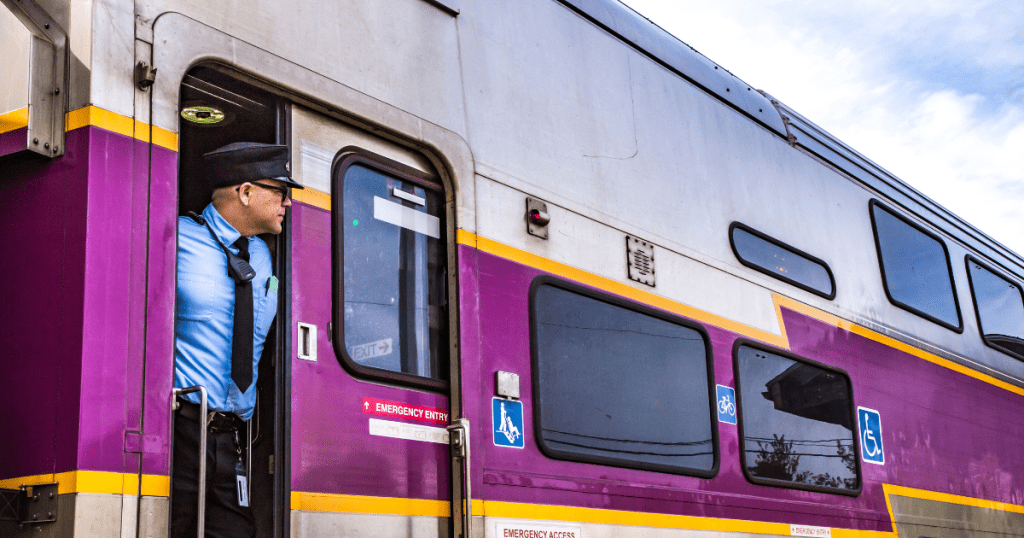
The MBTA Commuter Rail connects Boston with surrounding cities and towns, perfect for work commutes or weekend getaways! Sometimes referred to as the ‘Purple Line’, the Commuter Rail trains run from North Station and South Station to suburban destinations like Newburyport, Salem, Rockport, Foxboro, Providence, and Wachusett.
Like the “T”, Commuter Rail stations have “Inbound” and “Outbound” trains, traveling either towards downtown Boston or away from downtown. Unlike the “T”, the Commuter Rail’s “Inbound” and “Outbound” hubs are North Station and South Station. From North Station, you can access communities north and west of Boston, like Salem, Newburyport, Ipswich, or even Lincoln, Concord, or Wachusett. From South Station, you can travel to towns like Hingham, Scituate, Foxboro, or even Worcester.
How to Ride: Tickets, Schedules & Maps
Tickets for the Commuter Rail can be purchased as one-way, 1-Day, 7-Day, $10 Weekend Pass, 5-Day Flex, or Monthly Passes. Buy tickets in person at stations via ticket machines or on the train from the conductor, or the mTicket app. Ticket prices are determined by zones. Zone 1A includes most of the inner suburbs, while towns further from downtown are higher numbered zones. See the map of all the zones and their stations here. The special $10 Weekend Pass ticket allows for unlimited rides along the Commuter Rail all weekend long, no matter the zones of origin or destination stations.
The Commuter Rail Map and schedules are posted online, on the mTicket app, and in stations. Commuter Rail trains run on set schedules, with service on some lines starting as early as 5 AM. Extra trains are added to the schedule during peak commuting times Monday – Friday, 7 AM – 9 AM and 4 PM – 7 PM.

Special Seasonal Service:
Each summer, the MBTA Commuter Rail runs the special service CapeFlyer train. From Memorial Day to Labor Day, the CapeFlyer travels from South Station to Hyannis. This special service seasonal train allows riders to relax as they bypass traffic heading to Cape Cod. The CapeFlyer schedule can be found online. CapeFlyer tickets can be purchased in person at South Station or on the mTicket app.
3. MBTA Buses
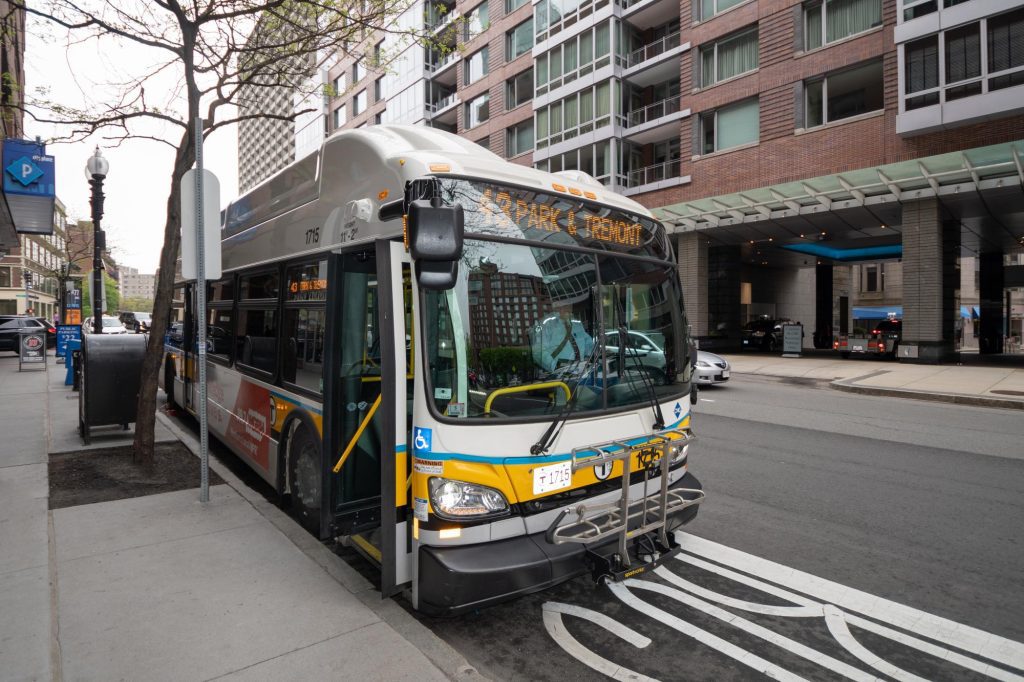
MBTA buses serve neighborhoods across the Greater Boston area that are not directly served by subway or train. These buses also connect residential areas to nearby “T” and Commuter Rail stations. You can choose between: local buses, which operate within Boston and the immediate surrounding areas and make frequent stops along their routes; and express buses, which travel from suburbs and communities outside of Boston, then drive directly into downtown Boston.
The Silver Line is a special bus rapid-transit route that connects key points in Boston, including South Station, Chinatown, the South End, the Seaport District and Logan Airport. The Silver Line is unique in its stops, fare collection, and subway-like experience with dedicated lanes in some sections of its route.
How to Use the Buses:
Download the Transit app or the MBTA’s online trip planner to find your route and schedule. Pay for your ride with a CharlieCard, CharlieTicket, or cash (exact change only).
Pro tip: If you’re running late for the “T”, check for nearby bus routes; you might be able to board a bus to your end location or the next closest “T” station!
4. MBTA Ferry
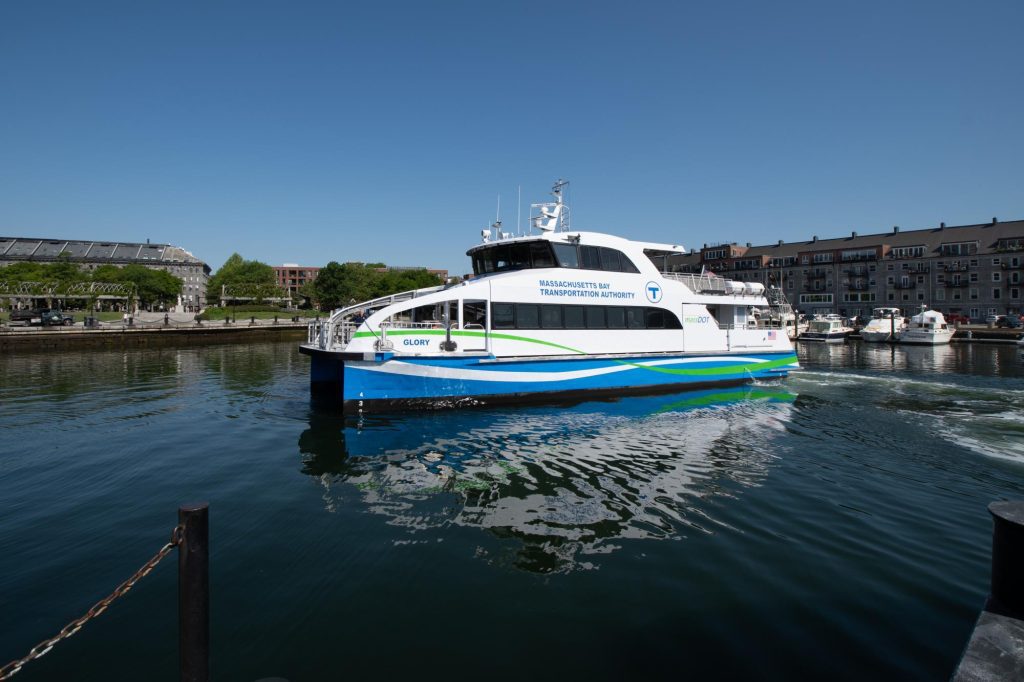
A unique way to commute or explore outside of Boston is by water! The MBTA ferries run between Boston, Hingham/Hull and Charlestown year-round. Seasonal service extends the ferry routes to Quincy, Winthrop and Lynn. The ferries offer a fast, scenic, and peaceful ride to your destination. The ferries provide another great alternative for those looking to avoid traffic and enjoy beautiful views.
How to Ride:
Ferry tickets can be purchased on-site as a paper ticket, with cash or via contactless payment or via the mTicket app. The map of ferry routes as well as ferry schedules can be found online.
5. Biking with Bluebikes
Boston’s bike-sharing program, Bluebikes, lets you rent a bike to ride around the city. Whether your focus is on fitness or fun, Bluebikes allow you to travel in an eco-friendly way. With a limit of 2 hours per ride, it’s the perfect option for short trips around town or sunny afternoon rides along the Charles River. With over 3,500 Bluebikes available to rent from 325 Bluebike stations across the city, staying active is never far from reach.
How To Use Bluebikes:
Download the Bluebikes app, find the nearest dock, and pay per ride or invest in a membership. Pro-tip: You can pick up a bike at any docking station and return it to another!

Taking Day Trips Without a Car: Keolis massAdventures
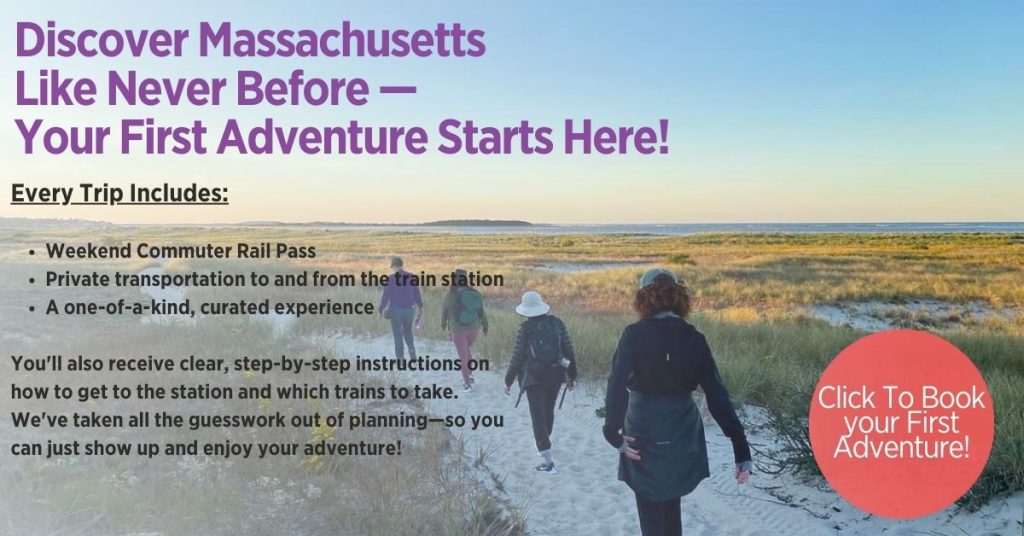
Want to make traveling outside of Boston even easier? For the first time ever, you can easily explore outside the city without renting a car or using a rideshare, with Keolis massAdventures. You can explore some of the most beautiful and exciting destinations in Massachusetts, all without needing a car or worrying about how to get there.
How it Works:
- Book a tour package with Keolis massAdventures online.
- On the day of your tour, board the designated Commuter Rail.
- Ride until your destination station, then disembark.
- Find, board, and sit back & relax on the chartered shuttle to your activity.
- Enjoy your activity!
- Catch the shuttle back to the station, to return via Commuter Rail to Boston.
Keolis massAdventures Packages include:
- Round-trip transportation from Boston via the Commuter Rail
- Commuter Rail $10 Weekend Pass
- Chartered shuttle to bring you from the destination station to your chosen activity
- Ticket to your chosen activity (historic estate tours, castle visits, brewery visits, outdoor adventures, and more).
This means that you can easily visit places like Hammond Castle Museum, Crane Estate, kayak in Gloucester or Rockport, or even enjoy breathtaking fall foliage on a hike in Ipswich!
Tips for Navigating Public Transportation as a New Bostonian
- Get an MBTA CharlieCard for discounted fares and faster boarding.
- Check service alerts before leaving, especially on weekends when maintenance is commonly scheduled.
- Plan extra time for transfers or connections, especially if you’re new to the system.
- Plan trips in advance, especially for weekend getaways.
- Remember your origin station (you’ll probably be returning there later), as well as your destination station – and pay attention as your ride commences, as transit can sometimes reach a stop quicker than you anticipated!
The Bottom Line
Moving to Massachusetts without a car isn’t just doable, it’s eco-friendly and can be fun! With Boston’s walkable streets, reliable public transit, and unique services like Keolis massAdventures, you can enjoy the city and beyond with ease. With the right know-how, you’ll find that you have endless adventures right at your fingertips. Whether you’re hopping on the “T” for your morning commute, catching a ferry for a scenic escape or taking a car-free day trip to a charming seaside town along the Commuter Rail, living in Boston without a car means having the freedom to do, see and go where you want, when you want!